Coming out was quite a step, but starting all over has many advantages. All forms of traces of use will remain my point of interest. As annotations could not exist without the text they refer to and in view of the fact that my decision to leave the Lyonese publications was instigated by my frustration at not being able to fully grasp the Latin texts, I have decided to switch to books in a language I do understand. Since my passive Portuguese is more or less fluent, I have chosen Lisbon editions as a starting point and postpone further decisions on expansion or limitation of the corpus until the size and content of this new corpus becomes clear. Interestingly an initial survey reveals almost all Lisbon titles in the collection of the University of Amsterdam to be in Portuguese, most of the Lyon books being in Latin.
In addition to the obvious traces of use I will look for any publishing information for the contemporary reader in the preliminary leaves and colophon, i.e. on content, price of the book, reason for publishing, and also make a cursory inventory of illustrations on the title pages, decorated initials (P.D. will surely appreciate that), head- and tail-pieces.
These past months have not been in vain as there is a bulk of material lying dormant in my computer for future reference.
29-10-2010

27-10-2010
Present
I have filed the one thousand plus photographs for future reference and changed the focus of my research.
While making a description of the traces of use in an interesting Lyonese book last week, I suddenly realised my inadequacy to continue with the corpus I had selected. In my enthusiasm I had not realised what effect not being able to read the books would have on my research. The meager Latin picked up at Highschool long ago and the Latin course I followed a couple of years ago at the University are helpful, but ultimately not enough to feel at ease studying Latin books and annotations, let alone annotations in Greek (which they often are, Lyon being an important city of Humanist thought).
This was last Friday. I spent the weekend cleaning up my computer, filing the Lyonese material and restarted Monday with a clean slate.
While making a description of the traces of use in an interesting Lyonese book last week, I suddenly realised my inadequacy to continue with the corpus I had selected. In my enthusiasm I had not realised what effect not being able to read the books would have on my research. The meager Latin picked up at Highschool long ago and the Latin course I followed a couple of years ago at the University are helpful, but ultimately not enough to feel at ease studying Latin books and annotations, let alone annotations in Greek (which they often are, Lyon being an important city of Humanist thought).
This was last Friday. I spent the weekend cleaning up my computer, filing the Lyonese material and restarted Monday with a clean slate.
24-10-2010
Past
More than seven months of scrutinizing 16th century Lyonnese books for traces of use have resulted in more than a thousand photographs
of ownership marks inside the books

of annotation marks

of annotations
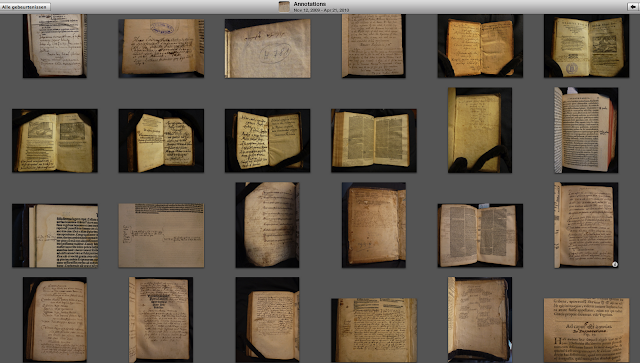
of other interesting traces of use
 and of their prices.
of ownership marks inside the books

of annotation marks

of annotations

of other interesting traces of use
 and of their prices.
22-09-2010


12-08-2010
P.D. seems to think I'm sitting here doing nothing.
How visible is a researcher at work?
I have been spending many hours behind my computer sorting through the pictures I made of the first fifty books of the corpus.
How visible is a researcher's work?
Thank you Julia for letting me realize I am not aware of my visibility.
How visible is a researcher at work?
I have been spending many hours behind my computer sorting through the pictures I made of the first fifty books of the corpus.
How visible is a researcher's work?
Thank you Julia for letting me realize I am not aware of my visibility.
27-07-2010
27-06-2010
Biding my time with useful thoughts on the snags of history: on the subjectivity of perception and of the interpretation of perception. David Perkins starts me off with his reference to Nietzsche's writings on 'historisches Bewusstsein':
'What distinguishes the present age from all past ones, he says, is that we know so much more about them than they did about each other. This knowledge is unhealthy. "Alien and disconnected" images from many times and place, a "carnival of gods, customs, and arts" fill our minds as a spectacle, but none are felt to be ours. As they collide in our minds, they are all relativized, and so also are whatever convictions and values characterize the present moment in history." (Perkins 1993. p.175).
If, as Nietsche claims, knowledge of the past colours the present, then the affected present will in its turn contaminate our notion of the past. Even if this is a supposition and not a fact, this seems an unstable basis for research, and I do remember reading a book about marginalia a couple of months ago, making a mental note not to let my own findings lead to unbased postulations.
To be continued.
'What distinguishes the present age from all past ones, he says, is that we know so much more about them than they did about each other. This knowledge is unhealthy. "Alien and disconnected" images from many times and place, a "carnival of gods, customs, and arts" fill our minds as a spectacle, but none are felt to be ours. As they collide in our minds, they are all relativized, and so also are whatever convictions and values characterize the present moment in history." (Perkins 1993. p.175).
If, as Nietsche claims, knowledge of the past colours the present, then the affected present will in its turn contaminate our notion of the past. Even if this is a supposition and not a fact, this seems an unstable basis for research, and I do remember reading a book about marginalia a couple of months ago, making a mental note not to let my own findings lead to unbased postulations.
To be continued.
16-06-2010
Sent in draft version number four with some 'minor' changes and an additional paragraph on an important 'why' question.
Why this corpus? Why research into ownership marks and marginalia in books printed in Lyon in the 16th century?
16th century Lyon was affluent, industrious, cosmopolitan and, after Paris, the most important cultural city in Renaissance France, which is reflected in the book production of 16th century printers of Lyon such as Sebastien Gryphe, Jean de Tournes, Charles Pesnot, Guillaume Laemarius, Guillaume Gazeau and Jacques Myt (Baudrier 1895, Cartier 1937, Gültlingen 2002, Mouren 2008).
The printers mentioned above were part of the enlightened humanist movement. Reading and writing were closely linked to education which did not end with schooling but was a lifelong experience of annotating and copying, ‘The humanist reader read with pen in hand’ (Grafton 2003, p.206). It can be assumed that a sizeable part of the 16th century Lyon collection in Special Collections has been owned and read by readers seeking education. Research into the traces of use left by these readers in the corpus aims to give insight into humanist reading customs.
Why this corpus? Why research into ownership marks and marginalia in books printed in Lyon in the 16th century?
16th century Lyon was affluent, industrious, cosmopolitan and, after Paris, the most important cultural city in Renaissance France, which is reflected in the book production of 16th century printers of Lyon such as Sebastien Gryphe, Jean de Tournes, Charles Pesnot, Guillaume Laemarius, Guillaume Gazeau and Jacques Myt (Baudrier 1895, Cartier 1937, Gültlingen 2002, Mouren 2008).
The printers mentioned above were part of the enlightened humanist movement. Reading and writing were closely linked to education which did not end with schooling but was a lifelong experience of annotating and copying, ‘The humanist reader read with pen in hand’ (Grafton 2003, p.206). It can be assumed that a sizeable part of the 16th century Lyon collection in Special Collections has been owned and read by readers seeking education. Research into the traces of use left by these readers in the corpus aims to give insight into humanist reading customs.
15-06-2010
The product of my silence of the past days: a better proposal?
Traces of Use. Ownership marks and marginalia in circa 500 books printed in Lyon 1487-1600, at Special Collections of the University of Amsterdam.
Introduction and theoretical framework
The focus of this research will be on ownership marks and marginalia in the University of Amsterdam collection of books printed in Lyon 1487-1600. The research will take place within the context of 16th century Lyon, the emphasis will be on the significance of the Lyonnese Humanist influence on publishing, printing and reading. A definition will be given of ownership marks and marginalia and an outline of their function in manuscripts and books. The value of ownership and marginalia research within the field of Book History will be explored, as will the methodological problems that are confronted during research.
Statement of the problem
Do the ownership marks and marginalia found in the corpus reflect the 16th century Humanist approach to history, education and philosophy?
Purpose of the study
The purpose of the study is to make an inventory and analysis of ownership marks, marginalia and other traces of use found in the corpus in order to interpret their meaning and to define their significance regarding research into the provenance and the contemporary reading of individual copies of a title.
Hypotheses
Due to traces of use, every copy of a title is unique. The traces of use found in the corpus will disclose information about the owners of the books and about their reading habits. The marginalia reflect the contemporary reader's contribution to humanist thought. The information gathered through studying traces of use can be applied toward a history of an individual copy of a title.
Questions
How does the research corpus relate to the overall production of 16th century printing in Lyon?
Questions concerning the interpretation of the ownership marks and marginalia (provenance and reception):
Are there ownership marks on the binding or inside the book. Can the contemporary owners be identified? What relationship is there between the owner and the genre of the book? What conclusions can be drawn from the quantity and genre of books with marginalia in relation to those without? Are the marginalia contemporary or later? What systems are used for annotating? What is the relevance of the marginalia to the text they accompany? In what way do the marginalia in the corpus reflect 16th century Humanist thought? What other manuscript texts besides annotations are to be found in the books?
And any further questions which will arise as the research develops. Looking for the unexpected.
The design - methods and procedures - instrumentation, data collection and data analysis
The research corpus will consist of circa 500 books printed in Lyon, France 1487-1600 at Special Collections of the University of Amsterdam.
The descriptions of the books and the inventory of the marginalia and ownership marks found in the corpus, will be collected and analysed in content management software Devonthink. Spreadsheet categories will be a.o.: U.v.A. call number; author; title; publisher; year when published; genre; ownership; manuscript date of ownership; types of marginalia; language used in marginalia; legibility; when acquired by the U.v.A.; binding; date of binding.
The temporary format is a blog in which trains of thought and actual results concerning the research are recorded from first activity on 9th March 2010, till conclusion, date unknown.
The purpose of the blog: notes to self, storage of material and reflection. A system to facilitate the picking up of thoughts sidelined at an earlier stage and a forum for exchange of information with peers.
Sampling
The case studies will consist of in depth investigation of the 16th century traces of use in a number of titles from the corpus. An attempt will be made to follow the titles' paths from the publisher to inclusion in the library of Amsterdam Special Collections with the objective of (re)creating the individual titles' reading-histories.
Limitation
Is a corpus of circa 500 books large enough to permit the drawing of conclusions?
Delimitation
Illegible annotations will be noted as 'illegible'. Their presence will be noted but not analysed.
Significance of the study
The significance of the study lies in what meaningful traces of use will be found in the corpus and what conclusions may be drawn upon these findings. Many titles have minimal descriptions in the U.v.A. library database, a more complete description could benefit further research.
References
http://tracesofuse.blogspot.com/
Pajares, F., Elements of a Proposal. Atlanta: Emory University, 2007. Online.
Amsterdam, 15th June 2010
Introduction and theoretical framework
The focus of this research will be on ownership marks and marginalia in the University of Amsterdam collection of books printed in Lyon 1487-1600. The research will take place within the context of 16th century Lyon, the emphasis will be on the significance of the Lyonnese Humanist influence on publishing, printing and reading. A definition will be given of ownership marks and marginalia and an outline of their function in manuscripts and books. The value of ownership and marginalia research within the field of Book History will be explored, as will the methodological problems that are confronted during research.
Statement of the problem
Do the ownership marks and marginalia found in the corpus reflect the 16th century Humanist approach to history, education and philosophy?
Purpose of the study
The purpose of the study is to make an inventory and analysis of ownership marks, marginalia and other traces of use found in the corpus in order to interpret their meaning and to define their significance regarding research into the provenance and the contemporary reading of individual copies of a title.
Hypotheses
Due to traces of use, every copy of a title is unique. The traces of use found in the corpus will disclose information about the owners of the books and about their reading habits. The marginalia reflect the contemporary reader's contribution to humanist thought. The information gathered through studying traces of use can be applied toward a history of an individual copy of a title.
Questions
How does the research corpus relate to the overall production of 16th century printing in Lyon?
Questions concerning the interpretation of the ownership marks and marginalia (provenance and reception):
Are there ownership marks on the binding or inside the book. Can the contemporary owners be identified? What relationship is there between the owner and the genre of the book? What conclusions can be drawn from the quantity and genre of books with marginalia in relation to those without? Are the marginalia contemporary or later? What systems are used for annotating? What is the relevance of the marginalia to the text they accompany? In what way do the marginalia in the corpus reflect 16th century Humanist thought? What other manuscript texts besides annotations are to be found in the books?
And any further questions which will arise as the research develops. Looking for the unexpected.
The design - methods and procedures - instrumentation, data collection and data analysis
The research corpus will consist of circa 500 books printed in Lyon, France 1487-1600 at Special Collections of the University of Amsterdam.
The descriptions of the books and the inventory of the marginalia and ownership marks found in the corpus, will be collected and analysed in content management software Devonthink. Spreadsheet categories will be a.o.: U.v.A. call number; author; title; publisher; year when published; genre; ownership; manuscript date of ownership; types of marginalia; language used in marginalia; legibility; when acquired by the U.v.A.; binding; date of binding.
The temporary format is a blog in which trains of thought and actual results concerning the research are recorded from first activity on 9th March 2010, till conclusion, date unknown.
The purpose of the blog: notes to self, storage of material and reflection. A system to facilitate the picking up of thoughts sidelined at an earlier stage and a forum for exchange of information with peers.
Sampling
The case studies will consist of in depth investigation of the 16th century traces of use in a number of titles from the corpus. An attempt will be made to follow the titles' paths from the publisher to inclusion in the library of Amsterdam Special Collections with the objective of (re)creating the individual titles' reading-histories.
Limitation
Is a corpus of circa 500 books large enough to permit the drawing of conclusions?
Delimitation
Illegible annotations will be noted as 'illegible'. Their presence will be noted but not analysed.
Significance of the study
The significance of the study lies in what meaningful traces of use will be found in the corpus and what conclusions may be drawn upon these findings. Many titles have minimal descriptions in the U.v.A. library database, a more complete description could benefit further research.
References
http://tracesofuse.blogspot.com/
Pajares, F., Elements of a Proposal. Atlanta: Emory University, 2007. Online.
Amsterdam, 15th June 2010
06-06-2010
The books and their markings will have to wait. It seems that theory goes before research, which is not so much surprising as regretful, having had a glimpse of all the wonderful material lying there waiting for me in the dungeons of the U.v.A.
Initial catchwords for the U.v.A. search machine: 16th century Lyon, Humanism(e), Renaissance. I prefer a systematic approach and will leave the marginalia for now. And so, here I am, confronted by a pile of French and English secundary literature with interesting titles such as Intellectual Life in Renaissance Lyon and L'humanisme lyonnais au XVIe siècle. Promising titles which will hopefully provide me with meaningful background for my research.
My eye is caught by an article on Maurice Scève (c.1500-c.1564). Does the U.v.A. collection also include work by him I wonder? Alas! Only twentieth reprints! Internet research produces an Italian antiquarian bookdealer who has a copy of the magnificant entrance of Henry II and Catharina de Medici in Lyon for sale: Scève's La Magnifica et Triumphale Entrata printed in Lyon 1549 by Guillaume Rovillé. Maybe the University could be persuaded that their Lyon collection would not be complete without a contemporary edition of this famous Lyonnese poet's work. The selling price is € 10.500... My first reaction: these Italian bookdealers, their prices are too much! But, further research reveals that only later, nineteenth and twentieth century critical editions of Scève are momentarily offered for sale. Might contemporary copies of Scève's work be that scarce?
One minute I am immersed in an article, the next, curiosity driven research. Did I not mention that earlier?
Initial catchwords for the U.v.A. search machine: 16th century Lyon, Humanism(e), Renaissance. I prefer a systematic approach and will leave the marginalia for now. And so, here I am, confronted by a pile of French and English secundary literature with interesting titles such as Intellectual Life in Renaissance Lyon and L'humanisme lyonnais au XVIe siècle. Promising titles which will hopefully provide me with meaningful background for my research.
My eye is caught by an article on Maurice Scève (c.1500-c.1564). Does the U.v.A. collection also include work by him I wonder? Alas! Only twentieth reprints! Internet research produces an Italian antiquarian bookdealer who has a copy of the magnificant entrance of Henry II and Catharina de Medici in Lyon for sale: Scève's La Magnifica et Triumphale Entrata printed in Lyon 1549 by Guillaume Rovillé. Maybe the University could be persuaded that their Lyon collection would not be complete without a contemporary edition of this famous Lyonnese poet's work. The selling price is € 10.500... My first reaction: these Italian bookdealers, their prices are too much! But, further research reveals that only later, nineteenth and twentieth century critical editions of Scève are momentarily offered for sale. Might contemporary copies of Scève's work be that scarce?
One minute I am immersed in an article, the next, curiosity driven research. Did I not mention that earlier?
27-05-2010
Meanwhile organizing the material found up until now is taking up a lot of time (well spent!). Am working offline on the first thirty primary titles, listing them by U.v.A. call number and joining the title descriptions with pictures and details on marginalia and ownership. Each book in a folder of its own.
Systematically working through the list structures my mind for further steps. For instance, which information management software should I use? Devonthink?
Systematically working through the list structures my mind for further steps. For instance, which information management software should I use? Devonthink?
18-05-2010
11-05-2010
Second draft: Proposal for research into ownership marks and marginalia in 500 books printed in Lyon 1487-1600 at Special Collections of the University of Amsterdam.
Introduction and theoretical framework
Why books printed in Lyon? Why marginalia?
Definition of ownership marks and marginalia, their historical function in manuscripts and books. The significance of ownership and marginalia research within the field of Book History.
What methodological problems are confronted when studying ownership marks and marginalia? The focus will be on Renaissance ownership marks and marginalia in the historical context of printers and printing in Lyon 1487-1600.
Statement of the problem
What can/do ownership marks and marginalia tell us about the reader/user history of 500 books printed in Lyon 1487-1600.
Purpose of the study
The purpose of the study is to make an inventory and analysis of ownership marks, marginalia and other traces of use found in the corpus in order to interpret their meaning and to define their significance regarding research into the provenance and (contemporary) reading of individual copies of a title.
Review of literature
What literary theory is applicable to marginalia? What adaptions are relevant?
Hypotheses
Due to traces of use, every copy of a title is unique. Traces of use disclose information about the readers/owners of the books and their reading habits. The information gathered through studying traces of use can be applied toward a history of an individual copy of a title.
Questions
Quantity of books with marginalia in relation to those without? What possible conclusions?
Interpretation of the ownership marks and marginalia:
Questions: can the (contemporary) owners be identified and/or placed? Are the marginalia contemporary or later? What systems are used for annotating? What is the relevance of the marginalia to the text they accompany? What other manuscript texts besides annotations are found in the books?
Provenance and reception: what conclusions can be drawn from the corpus at Amsterdam Special Collections related to 16th century printing in Lyon? To what countries did the books go to be bound and read? Country specific indications and/or deviations? In what way do the marginalia in the corpus reflect 16th century humanist enlightenment?
And further questions which will arise as the research developes. Looking for the unexpected.
The design - methods and procedures - instrumentation, data collection and data analysis
The research corpus: circa 500 books printed in Lyon, France 1487-1600 at Special Collections of the University of Amsterdam. Inventory of marginalia and ownership marks in the corpus: survey and pictures.
Spreadsheet categories a.o.: U.v.A. call number; author; title; publisher; year when published; genre; ownership; manuscript date of ownership on front endpaper or elsewhere; various types of marginalia; language used in marginalia; legibility; when acquired by the U.v.A.; binding; date of binding.
The temporary format: a blog in which trains of thought and actual results concerning the research are recorded from first activity on 9th March 2010, till conclusion, date unknown.
The purpose of the blog: notes to self, storage of material and reflection. System to facilitate the picking up of thoughts sidelined at an earlier stage. Sharing facts and questions with peers.
http://tracesofuse.blogspot.com/ [recursive Droste effect]
Sampling
Case studies: confirmation and exception.
Limitation
Is a corpus of 500 books large enough to permit the drawing of conclusions?
Delimitation
Illegible annotations will be noted as 'illegible'. Their content will not be analysed.
Significance of the study
The significance of the study lies in what meaningfull traces of use will be found in the corpus and what conclusions may be drawn upon these findings. Many titles have minimal descriptions in the U.v.A. library database, a more complete description could benefit further research.
References
Van Holthe tot Echten, P.H., Ten Packages of Sheets of Paper Printed in Lyon. Where did they go? Essay for a master course in 'Book History'. U.v.A. 2010. Online.
Pajares, F., Elements of a Proposal. Atlanta: Emory University, 2007. Online.
07-05-2010
Have thrown the first outline into the waste-paper basket and made a new start using F. Pajares' The Elements of a Proposal for reference.
Very useful !!!!
In the meantime also organizing the Lyon titles by call number and thinking about the spreadsheet to be. Shouldn't wait to long to start filling in the specifics.
06-05-2010
The research proposal. A first outline.
TRACES OF USE
Proposal for a research project concerning a collection of books owned by Special Collections of the University of Amsterdam, The Netherlands.
The corpus:
Circa 500 books printed in Lyon, France 1475-1600.
The focus:
Ownership marks and marginalia on the bindings and in the books.
The proposal:
Inventory and analysis of ownership marks, marginalia and other traces of use found in the corpus mentioned above. Looking for generalisations and deviations.
Context:
Historical context, printers and printing in Lyon 1475-1600.
Theoretical issues:
Marginalia research, its place within the field of Book History. Focus on Renaissance ownership marks and marginalia. What existing literary theory is applicable to marginalia? What adaptions are neccessary?Definition of ownership marks. Identification possiblities and problems.
Definition of marginalia. What methodological problems are confronted when studying marginalia? What is required to uncover the meaning of marginalia? To what extent is interpretation of marginalia possible?
The research:
Inventory of marginalia and ownership marks in the corpus: survey and pictures.
Spread sheet categories: U.v.A. call number; author; title; publisher; year when published; genre; ownership; types of marginalia; language used in marginalia; manuscript date of ownership on front endpaper or elsewhere; when acquired by the U.v.A.; binding; date binding.
Quantity of books with marginalia in relation to the marginalia-less? Conclusions?
Interpretation of the ownership marks and marginalia. Questions to be asked: can the (contemporary) owners be identified and/or placed? Are the marginalia contemporary or later? What is the relevance of the marginalia to the book they are in? What systems are used for annotating. Other manuscript texts in the book besides annotations?
Provenance and reception: what conclusions can be drawn from the corpus at Special Collections related to 16th century printing in Lyon? To what countries did the books go to be bound and read? Country specific indications and/or deviations? In what way do the marginalia in the corpus reflect 16th century humanist enlightenment? And further questions which will arise as the research developes. Looking for the unexpected.
The case studies:
Confirmation and exception.
The temporary format:
A blog in which trains of thought and actual results concerning the research are recorded from the first activity on 9th March 2010, till conclusion, date unknown.
The purpose of the blog: notes to self, storage of thoughts and material. System to facilitate the picking up of thoughts sidelined at an earlier stage. Sharing thoughts and questions with peers.
http://tracesofuse.blogspot.com/
Proposal for a research project concerning a collection of books owned by Special Collections of the University of Amsterdam, The Netherlands.
The corpus:
Circa 500 books printed in Lyon, France 1475-1600.
The focus:
Ownership marks and marginalia on the bindings and in the books.
The proposal:
Inventory and analysis of ownership marks, marginalia and other traces of use found in the corpus mentioned above. Looking for generalisations and deviations.
Context:
Historical context, printers and printing in Lyon 1475-1600.
Theoretical issues:
Marginalia research, its place within the field of Book History. Focus on Renaissance ownership marks and marginalia. What existing literary theory is applicable to marginalia? What adaptions are neccessary?Definition of ownership marks. Identification possiblities and problems.
Definition of marginalia. What methodological problems are confronted when studying marginalia? What is required to uncover the meaning of marginalia? To what extent is interpretation of marginalia possible?
The research:
Inventory of marginalia and ownership marks in the corpus: survey and pictures.
Spread sheet categories: U.v.A. call number; author; title; publisher; year when published; genre; ownership; types of marginalia; language used in marginalia; manuscript date of ownership on front endpaper or elsewhere; when acquired by the U.v.A.; binding; date binding.
Quantity of books with marginalia in relation to the marginalia-less? Conclusions?
Interpretation of the ownership marks and marginalia. Questions to be asked: can the (contemporary) owners be identified and/or placed? Are the marginalia contemporary or later? What is the relevance of the marginalia to the book they are in? What systems are used for annotating. Other manuscript texts in the book besides annotations?
Provenance and reception: what conclusions can be drawn from the corpus at Special Collections related to 16th century printing in Lyon? To what countries did the books go to be bound and read? Country specific indications and/or deviations? In what way do the marginalia in the corpus reflect 16th century humanist enlightenment? And further questions which will arise as the research developes. Looking for the unexpected.
The case studies:
Confirmation and exception.
The temporary format:
A blog in which trains of thought and actual results concerning the research are recorded from the first activity on 9th March 2010, till conclusion, date unknown.
The purpose of the blog: notes to self, storage of thoughts and material. System to facilitate the picking up of thoughts sidelined at an earlier stage. Sharing thoughts and questions with peers.
http://tracesofuse.blogspot.com/
22-04-2010
Left Amsterdam for the Bourgogne via Sophie Calle in the De Pont Museum in Tilburg. A callous goodbye email, the last sentence being: Prenez soin de vous. Reflections, dissections, annotations by 107 women. Email-marginalia.
The last 300 kilometers through hilly country sunlight. Will start reading William Sherman's Used Books tomorrow. Sherman's work was kindly recommended to me some time ago and I was happily surprised to find a second hand copy in an antiquarian bookstore nearby. The description on internet said: 'with pencil markings'. I found myself not liking the idea of someone else's markings. Strange, here I am, studying 16th/17th century marginalia while annotations by what is almost sure to be a peer might put me off? I decided to give the pencil marked book a chance. Tomorrow the proof of the pudding.
The last 300 kilometers through hilly country sunlight. Will start reading William Sherman's Used Books tomorrow. Sherman's work was kindly recommended to me some time ago and I was happily surprised to find a second hand copy in an antiquarian bookstore nearby. The description on internet said: 'with pencil markings'. I found myself not liking the idea of someone else's markings. Strange, here I am, studying 16th/17th century marginalia while annotations by what is almost sure to be a peer might put me off? I decided to give the pencil marked book a chance. Tomorrow the proof of the pudding.
18-04-2010
Ten days and twenty books since I started getting into the real stuff. Spent most of my time in the library, drowning in letters. Twenty books is nothing compared to the thousands and thousands studied by marginalia-scholars, but, even so, I am pleased with the findings and looking forward to continuing in a next library stretch. For now there is a lot of material to be processed and will have plenty of time to do so since another visit to Bourgogne is forthcoming. But before 'internetless in Bourgogne' still time for a couple of days of internet activity. I must plan them well.
14-04-2010


13-04-2010
Abonneren op:
Posts (Atom)